

Night Vision Buying Guide
ZULUS HD V2 vs ZULUS 4K vs NVMD-C200: Which DNT Night Vision Suits You?
DNT's three digital night vision lines each solve a different problem. The ZULUS HD V2 is the everyday rifle scope, and at A$1,198.95 it's the cheapest way into the range with a rangefinder built in. The ZULUS 4K is the detail-first scope for longer shots. The NVMD-C200 is a compact 1–6x unit that adds night vision to the red dot or day scope you already run. For most fox and rabbit shooters, we'd start with the HD V2.
The three side by side, at Australian prices
All three use a digital sensor feeding a 1920×1080 Micro-OLED display. They connect to the DNT app over Wi-Fi, carry an IP67 rating and record video to built-in memory. Where they split is magnification, ranging, battery life and how they sit on the rifle.
The diagram below puts them on the same magnification scale with Xhunter's current prices. One thing stands out straight away: in Australia the NVMD-C200 and the ZULUS 4K are a dollar apart, so the choice between those two comes down to how you shoot.
| ZULUS HD V2 (3–12x / 5–20x) | ZULUS 4K | NVMD-C200 | |
|---|---|---|---|
| Xhunter price | A$1,198.95 (either) | A$1,399.95 | A$1,398.95 (combo) |
| Sensor | Sony STARVIS 2, 1920×1080, 60 Hz | Sony STARVIS 2 4K, 3840×2160 | 1920×1080, 50 fps |
| Lens | ED glass | 50 mm f/1.8 ED | f/1.2 |
| Magnification | 3–12x or 5–20x digital | 3–24x digital | 1–6x digital |
| Rangefinder | 5–1,000 m, ballistic calculator | 5–1,300 yd (about 1,190 m), DNT Ballistic Engine | None |
| Battery | 21700, 10 h rated | 21700, 6 h rated | 18650, 6 h rated |
| Net weight | 522 g / 542 g | 690 g | 390 g |
| Mounting | Fits DNT QDM150 QD mount | 30 mm tube in standard rings | QD mounts (QDS150, QDF170) |
| Memory | 32 GB | 64 GB | 32 GB |
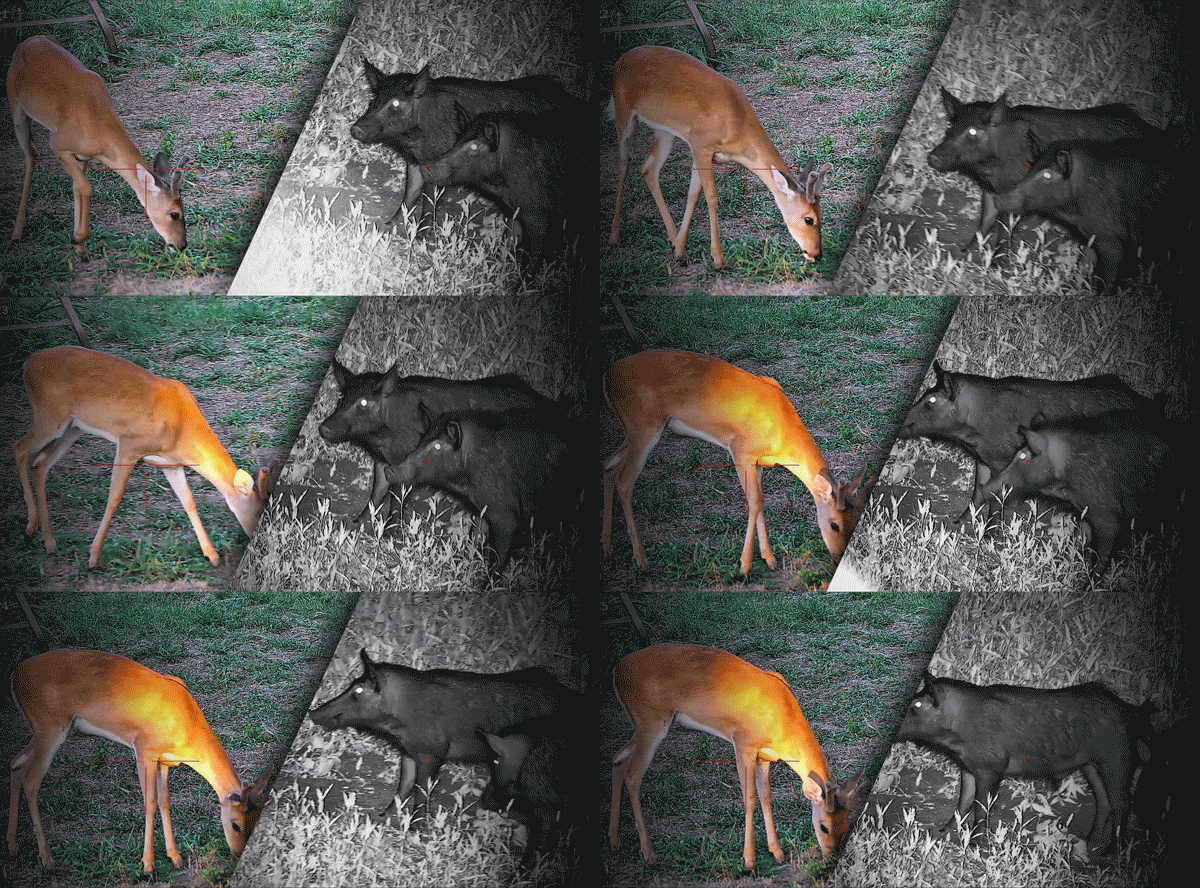
ZULUS HD V2: where most hunters should start
The HD V2 is built like a conventional scope. You zoom with a ring and throw lever, which is easy to find with gloves on, and the Micro-OLED display peaks at 1,800 nits, so the picture stays readable in full sun as well as at night.
Battery life is its strongest card. One 21700 cell is rated for 10 hours, the longest of the three, which covers a full winter fox night without a swap. The built-in rangefinder reads from 5 to 1,000 m, and the ballistic calculator turns that distance into a holdover on screen. You can set up your loads on the scope itself or in the DNT app.
The two versions cost the same, so pick on magnification. The 3–12x (ZHD312R-V2) suits shooting inside about 150 m: rabbits around the sheds, or foxes coming in to a whistle along a creek. The 5–20x (ZHD520R-V2) is the better fit for open paddocks, where you want more reach. It's 20 g heavier at 542 g and about 10 mm longer.
The HD V2's limit is the sensor. At 1920×1080 it gives a clean picture at normal hunting distances, but when you're zoomed right in on something far away, there's less detail to work with than the 4K's sensor provides. For really dark nights, it takes DNT's IR940V-M24 940 nm IR module.
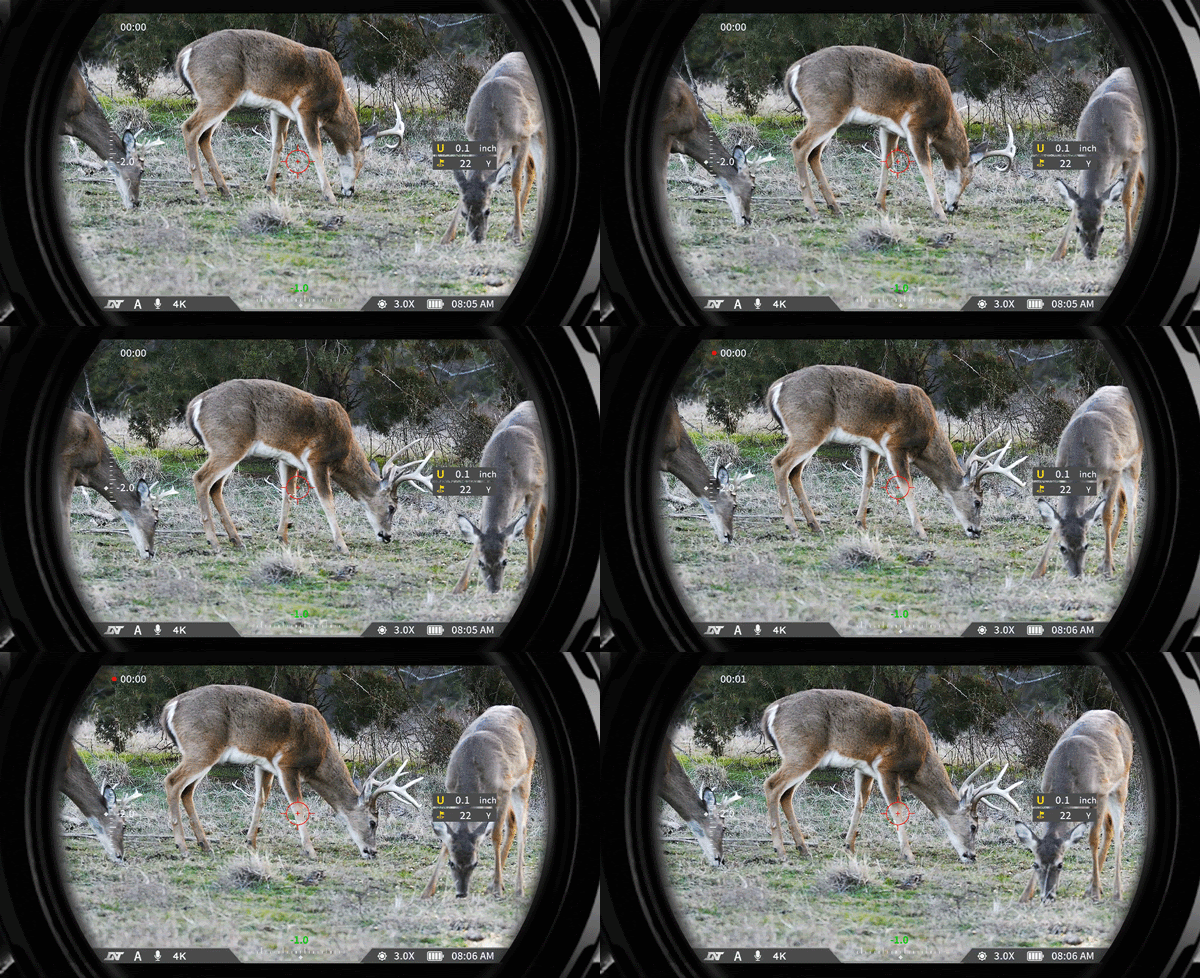
ZULUS 4K: more pixels for longer shots
The 4K in the name refers to the sensor: 3840×2160 pixels behind a 50 mm f/1.8 ED lens. The display and recorded video are both 1080p. Those extra sensor pixels are what let DNT offer up to 6x lossless digital zoom within the 3–24x range, so a distant animal keeps its edges when you zoom in.
Light is the variable that matters. DNT designed the 4K mode, which runs at 30 fps, for long-range clarity in good light. Switch to 1080p mode and the sensor runs at 60 fps for smoother movement. The laser is rated to 1,300 yards (about 1,190 m), though a fox-sized target in grass ranges well short of a rangefinder's maximum.
Say you're glassing an open wheat stubble paddock at last light, with a fox working the far fence 300 m out. The HD V2 will find it. We'd expect the 4K to give you the clearer picture of what it is before you range it.
The trade-off is weight and endurance. The 4K weighs 690 g on its own and about 895 g with battery and rings, it's 347 mm long, and its 21700 battery is rated for 6 hours. It also has no built-in IR illuminator, and DNT recommends adding an external one for pitch-black nights or long-range night shooting.
NVMD-C200: night vision for the gear you already own
The NVMD-C200 starts at a true 1x. Its field of view is 27.0° × 15.4°, which by our calculation covers about 48 m across at 100 m. At its lowest setting, the 4K covers about 15.4 m. The diagram below draws both to scale, and it shows why the NVMD suits fast, close work.
It mounts in four ways, shown in the next diagram: behind a red dot as a magnifier, in front of a day scope as a clip-on, on its own as a 1–6x scope, or flipped to the side as an action camera. DNT says it keeps your daytime zero in the clip-on and magnifier roles, because your existing optic still does the aiming. The camera role needs DNT's QDF170 flip-to-side mount.
Picture pushing through thick blackberry and timber in Gippsland at night, with a pig breaking 30 m ahead. A 3x minimum would fill the screen with a patch of hide. The NVMD at 1x shows you the whole animal and the ground around it. At 390 g, it's also the lightest of the three. It has four imaging modes: full colour, white phosphor, green phosphor, and black and white.
The NVMD leaves out the things the ZULUS scopes are built around. It has no rangefinder, no ballistic calculator and no built-in IR, and it runs at 50 fps rather than 60. Because it costs about the same as the 4K here, buy it for flexibility rather than to save money. Xhunter sells it as a combo, so check the product page for what's in the box.
Which one to buy
The flow below covers most buyers in four questions. The distances in it are our rule of thumb, not DNT figures.
For spotlighting foxes and rabbits on your own place, the ZULUS HD V2 gives you the most for the money: rangefinder, ballistics and the longest battery life, at the lowest price of the three. Choose the 4K if you mostly take longer shots in fair light and you'll use the extra detail. Choose the NVMD-C200 if you already have a red dot or day scope you trust and want night vision without moving or re-zeroing it.
Skip all three if what you really need is to find animals by their body heat at a distance. Digital night vision works with reflected light, while a thermal picks up body heat, so on a dark night a thermal will usually find a fox well before any of these will. Our guide to how thermal and digital night vision differ explains why. If you want both in one unit, the DNT ThermNight TNC4K219R review covers a combined thermal and 4K digital scope.
Before the first night out
Sort out the mounting at home first. The 4K is a 30 mm tube that goes in standard rings, so check your base with our guide to Weaver, Picatinny and dovetail rails. If you plan to move an HD V2 between rifles, DNT's QDM150 quick detach mount fits it, and the app keeps a separate ballistic profile for each load. Whichever you choose, plan for IR: all three see much further in true darkness with an illuminator, and the 4K and NVMD have none built in.
Compare the three on our product pages
Check current stock and what's included before you choose.
ZULUS HD V2ZULUS 4KNVMD-C200DNT ZULUS and NVMD-C200 FAQ
Is the ZULUS 4K worth the extra over the ZULUS HD V2?
It's worth it if most of your shots are long and taken in fair light. The 4K's 3840×2160 sensor and 50 mm f/1.8 lens hold more detail when zoomed, and its rangefinder is rated to 1,300 yards. The HD V2 costs A$201 less, weighs less and runs 10 hours on one battery compared with the 4K's 6, so for most spotlighting inside about 200 m it's the better buy.
What's the difference between the ZHD312R-V2 and the ZHD520R-V2?
The only real difference is magnification. The ZHD312R-V2 runs 3–12x and suits close country and rabbits inside about 150 m. The ZHD520R-V2 runs 5–20x for open paddocks and longer shots. Both have the same sensor, display, 5–1,000 m rangefinder, ballistic calculator and 10-hour battery rating. At Xhunter both cost A$1,198.95. The 5–20x weighs 542 g, 20 g more than the 3–12x.
Does the ZULUS 4K record video in 4K?
No. The ZULUS 4K records 1920×1080 video. The 4K figure refers to its 3840×2160 sensor, and the display is also 1080p. DNT uses the extra sensor pixels for up to 6x lossless digital zoom, so the image stays sharp when you zoom in on a distant animal. Footage is saved to 64 GB of built-in memory and can be managed through the DNT app.
Do I need an IR illuminator with DNT digital night vision?
On dark, moonless nights, yes. Digital night vision amplifies the light that's available, and an infrared illuminator gives it light the eye can't see. The ZULUS 4K and NVMD-C200 have no built-in IR, and DNT recommends an external illuminator for pitch-black conditions. The ZULUS HD V2 takes DNT's IR940V-M24 940 nm module. With a bright moon, all three can work without added IR at shorter range.
Can the NVMD-C200 measure range or calculate holdover?
No. The NVMD-C200 has no laser rangefinder and no ballistic calculator. It's designed as a 1–6x multi-purpose unit for close, fast work, and as a clip-on or magnifier your existing optic still does the aiming. If you want ranging and on-screen holdover, look at the ZULUS HD V2, which ranges from 5 to 1,000 m, or the ZULUS 4K, rated to 1,300 yards.
How long do the batteries last on each DNT model?
DNT rates the ZULUS HD V2 at 10 hours on one 21700 flat-top battery, the ZULUS 4K at about 6 hours on a 21700, and the NVMD-C200 at about 6 hours on an 18650 flat-top. Cold nights shorten lithium battery life, so carry a charged spare for the 4K or NVMD on a long winter session. All three can also run from 5V USB-C external power.
Can I use the NVMD-C200 in front of my existing day scope?
Yes. The clip-on role puts the NVMD-C200 in front of your day scope, and DNT says your daytime zero is kept because the day scope still does the aiming. It mounts on DNT's QD mounts, so it can come off for daytime shooting. It can also sit behind a red dot as a night vision magnifier, which suits AR-style rifles and close-range work.
Can I move a ZULUS HD V2 between rifles?
Yes. The ZULUS HD V2 is compatible with DNT's QDM150 quick detach mount, so it can come off one rifle and go on another without tools. The DNT app stores separate ballistic profiles, so you can pick the profile that matches the rifle and load. Check your zero after every swap before you shoot at game, as even QD mounts can shift slightly.
Are DNT night vision scopes waterproof?
All three are rated IP67, which means they're dust-tight and protected against short immersion in water. That covers rain, drizzle and a fall in a creek, not long soaking. DNT rates the ZULUS HD V2 to operate from −20 to 50 °C. After a wet night, dry the unit before charging it or opening the battery cap so moisture stays out of the battery compartment.
Do these scopes work in daylight?
Yes. All three are day and night units and show a full-colour image in daylight. The ZULUS HD V2's display reaches 1,800 nits peak brightness to stay readable in sun, and the ZULUS 4K's sensor is at its sharpest in good light. The NVMD-C200 has a full-colour day mode alongside its white phosphor, green phosphor, and black and white night modes.
Which DNT night vision is best for foxes in Australia?
For most fox shooters, the ZULUS HD V2 is the best fit. It has a built-in rangefinder and ballistic calculator, a 10-hour battery rating, and it costs A$1,198.95 at Xhunter. Choose the 5–20x for open paddocks or the 3–12x for closer country. Choose the ZULUS 4K if your foxes are mostly at long range in open country and you want maximum detail.
Is digital night vision or thermal better for spotting animals?
Thermal is better for finding animals and digital night vision is better for identifying them. A thermal picks up body heat in total darkness, so a warm fox stands out against cooler ground at a distance. Digital night vision shows a natural-looking image with real detail, but it needs some light or an IR illuminator. Many hunters scan with a thermal and shoot through a digital scope.
Specifications are taken from DNT's published spec sheets and product pages; prices are Xhunter's listed prices in November 2026.