

Review
Pulsar Telos LRF XT50 Review: Is the Flagship Worth It?
The Pulsar Telos LRF XT50 is worth it if you glass big, open country and want to clear it in fewer sweeps. Its 1280×1024 sensor goes mostly into a wider view rather than a closer one, so it suits hunters who scan paddocks and plains. If you mostly work fence lines and timber at moderate range, the Telos LRF XL50 gets you most of the way for considerably less.
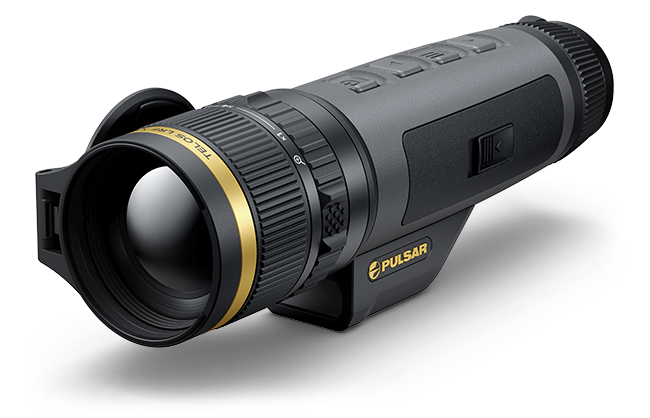
If you're still choosing between all nine Telos models, start with our Pulsar Telos buyer's guide. This review looks only at the flagship and who should pay for it.
Where the extra pixels actually go
Here's the detail that changes the decision. The XT50 and the XL50 both use 12 µm pixels behind a 50 mm F1.0 lens. That means each pixel covers the same patch of ground: about 2.4 cm at 100 m, by our calculation. A fox at 300 m lands on the same number of pixels in either unit when both sit at the same magnification.
The XT50's extra 256 columns and 256 rows go around the edges instead. The diagram below shows the result at 100 m.
So the XT50 gives you more scene, not more zoom, and that's still a big deal. Pulsar rates its view at 17.5°, the widest in the Telos family, and its 2× base magnification is the lowest in the range, so the wide view is what you see first. Pulsar's own reviewer, Erik Bjaelkvall, frames it the same way: fewer sweeps to clear a treeline and an easier time following movement at the edges.
Scanning open country
Say you're on a stubble paddock out west at last light, looking for pigs that come off the creek to feed. Every sweep you don't have to make is time you're watching instead of searching. The chart below shows how much ground one view covers at three distances.
At 300 m, the XT50 takes in about 92 m of paddock in one view against the XL50's 74 m. Over a night of scanning, that 25% adds up to fewer sweeps and fewer gaps.
The display matters here too. The XT50 uses a 1920×1080 AMOLED screen, against 1024×768 on the other Telos models, which gives the bigger sensor room to show what it captures. Pulsar also added electronic image stabilisation, which steadies the picture when you zoom in on a distant animal by hand. Pulsar lists the magnification as 2–16×, extending to 24× with Zoom Boost.
The rangefinder and the rest
The built-in laser rangefinder reaches 1,200 m with ±1 m accuracy, up from 1,000 m on the earlier Telos LRF models, and Pulsar says it locks on faster. It offers single measurements and a continuous scan mode. In practice, a pig at a few hundred metres is well inside its reach; the extra range is more about quicker, more confident readings than shooting further.
The comparison below lists everything that changes between the XT50 and the LRF XL50.
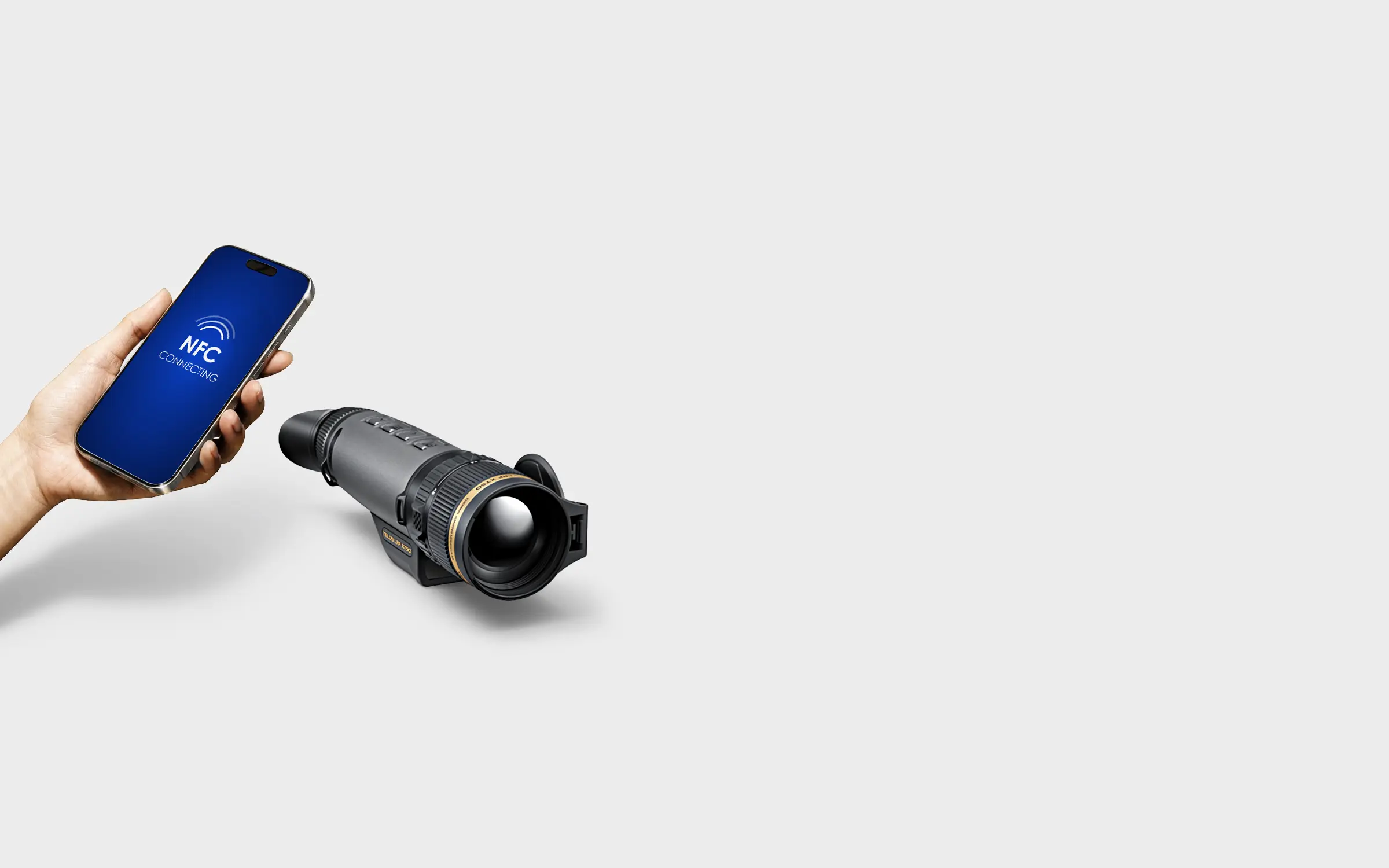
Two additions are easy to overlook. With 128 GB of memory and 1440×1080 video, you can record a whole season without clearing the unit. And NFC pairing lets you tap your phone on the monocular to connect Stream Vision 2, with no menus to work through. Pulsar currently lists NFC as an XT50-only feature.
The trade-offs
Price is the obvious one: the XT50 sits at the top of the Telos range, a substantial step above the LRF XL50. It weighs 0.73 kg with the battery, the same as the LRF XL50 but more than you'll notice on a short walk. Its eye relief is 13 mm, a millimetre shorter than the other Telos models, so glasses wearers will find it tighter; the −5 to +4 dioptre adjustment lets many people use it without glasses instead.
And because the extra resolution mostly widens the view, a hunter who works close country won't get full value from it. In thick timber, where you rarely see past 150 m, the XL50 or even the XP50 makes more sense.
Our verdict
For hunters who glass open paddocks, plains and hillsides before deciding where to go, the Telos LRF XT50 is the best monocular in the range and the one we'd choose. It clears ground faster, shows more on screen and ranges further. Skip it if you mostly hunt close country or occasional nights; the LRF XL50 gives you the same pixel detail on target and a capable rangefinder for less.
Pulsar Telos LRF XT50 at Xhunter
Check the current price and stock on the product page.
View the Telos LRF XT50Telos LRF XT50 FAQ
Is the Pulsar Telos LRF XT50 worth buying?
It's worth it if you regularly scan large open areas, such as paddocks, plains or hillsides, and want the widest view in the Telos range. Its 1280×1024 sensor gives a 17.5° field of view, a 1920×1080 display and a 1,200 m rangefinder. For close country or occasional use, the Telos LRF XL50 offers the same pixel detail on target for less.
Does the Telos XT50 show more detail on a distant animal than the XL50?
At the same magnification, no. Both use 12 µm pixels behind a 50 mm lens, so by our calculation each pixel covers about 2.4 cm at 100 m in either unit, and a fox lands on the same number of pixels. The XT50's extra resolution widens the field of view to 17.5° and fills a sharper 1920×1080 display.
How far does the Telos LRF XT50 rangefinder reach?
Pulsar rates the Telos LRF XT50's laser rangefinder to 1,200 m with ±1 m accuracy, up from 1,000 m on earlier Telos LRF models. It offers single measurements and continuous scanning, uses a 905 nm laser and is a Class 1 laser product. Real ranging distance depends on the target's size and reflectivity and on the weather.
Does the Telos XT50 have image stabilisation?
Yes. Pulsar lists electronic image stabilisation on the Telos LRF XT50. It steadies the picture when you hold the monocular by hand at higher magnification, where your own movement becomes the limit. It won't replace a solid rest or tripod for long observation, but it makes the top of the zoom range more usable.
What does Zoom Boost mean on the Telos XT50?
Pulsar lists the Telos LRF XT50's magnification as 2× to 16×, extending to 24× with Zoom Boost. All of that beyond 2× is digital magnification of the same sensor image, so the extra zoom enlarges what the sensor already captured rather than adding new detail. It's most useful with the electronic image stabilisation switched on.
How long does the Telos LRF XT50 battery last?
Pulsar rates the Telos LRF XT50 at about 8 hours on its LPS 7i battery at 22°C, against 7 hours for the XL50. The 6,400 mAh pack is replaceable in the field, charges through USB-C with Power Delivery and also supports wireless charging. Recording, Wi-Fi and cold weather will shorten the runtime.
What is NFC pairing on the Telos XT50?
NFC pairing lets you tap your phone against the Telos LRF XT50 so the Stream Vision 2 app connects automatically, without searching for networks or entering Wi-Fi details. Pulsar currently lists NFC as available on the XT50 only. The other Telos models connect to Stream Vision 2 through the usual Wi-Fi setup.
How much video can the Telos LRF XT50 store?
The Telos LRF XT50 has 128 GB of built-in memory, double the 64 GB in other Telos models, and records video and photos at 1440×1080 in MP4 and JPG formats. That's enough for many nights of recording before you need to download files to your phone through Stream Vision 2 or clear the memory.
Is the Telos XT50 good for people who wear glasses?
It's workable, but tight. Pulsar lists the Telos LRF XT50's eye relief at 13 mm, slightly less than the 14 mm of other Telos models, so glasses wearers may not see the full image. The −5 to +4 dioptre adjustment lets many users focus the display without glasses, which is often the more comfortable option.
How heavy is the Pulsar Telos LRF XT50?
Pulsar lists the Telos LRF XT50 at 0.73 kg and 242 × 72 × 77 mm. That's the same weight as the Telos LRF XL50 and a little more than the non-rangefinder Telos models. It sits comfortably in one hand, and the supplied carrying case helps spread the weight on long walks.
What comes in the box with the Telos LRF XT50?
Pulsar lists the Telos LRF XT50, an LPS 7i rechargeable battery, a charger, a USB-C cable, a carrying case, a neck strap, a cleaning cloth and user documentation. Contents can vary by market, so check the product page or ask us to confirm the Australian kit before ordering.
Can the Telos LRF XT50 be mounted on a tripod?
Yes. Pulsar says the XT50 has a built-in tripod mounting point, and its specification lists a 1/4-inch adaptor. A tripod is useful for long observation sessions or for steady recording at higher magnification. Pulsar also offers Telos-specific tripod adapters for users who want a quick-release setup.
This review is based on Pulsar's published specifications and its Telos LRF XT50 review; coverage and pixel figures are our own calculation.