

Comparison
Telos XP50 vs XG50: Same 640 Sensor, Different Jobs
If you're stuck between the Telos XP50 and the Telos XG50, the choice comes down to how you hunt. The XP50 suits hunters who scan wide and work on muggy or damp nights, where its sensitivity shows. The XG50 suits hunters who glass open country at longer range and want more pixels on a distant animal. Both use a 640×480 sensor, so this isn't a resolution decision at all.
Both also come with or without a built-in rangefinder: the Telos LRF XP50 and Telos LRF XG50. Our Pulsar Telos buyer's guide covers the whole range; this article goes deeper on these two.
Same pixel count, different pixel size
The difference starts with pixel pitch, the size of each sensor pixel. The XP50's pixels are 17 µm; the XG50's are 12 µm. Behind the same 50 mm F1.0 lens, that changes how much ground each pixel covers, as the diagram below shows.
Each XP50 pixel covers about 3.4 cm at 100 m, by our calculation, so 640 of them span 21.8 m. Each XG50 pixel covers about 2.4 cm, so 640 span 15.4 m. In practice, the XP50 shows you more of the paddock at once, while the XG50 puts more pixels on whatever you're looking at. A fox at 200 m covers roughly 10 pixels lengthways on the XP50 and roughly 15 on the XG50.
That's also why the XG50 starts at 3.5× magnification against the XP50's 2.5×, and why Pulsar rates its detection range at 2,300 m against 1,800 m.
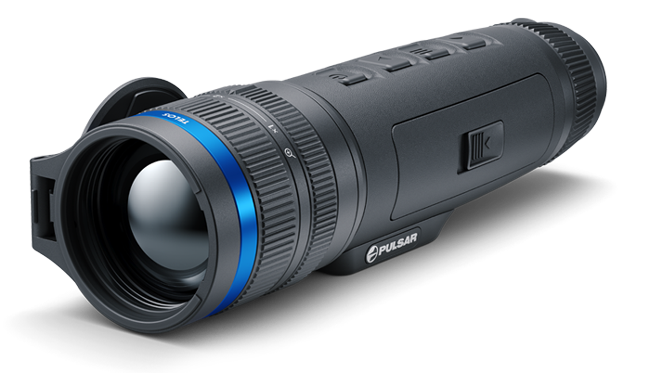
Where the XP50 earns its place
Picture a muggy January night after a storm. The ground, the grass and the fence posts have all soaked up the day's heat, and a fox barely stands out from the dirt behind it. That's a low-contrast scene, and it's where sensitivity matters more than resolution.
NETD measures the smallest temperature difference a sensor can separate; lower is better. Pulsar rates the XP50's sensor at under 18 mK against the XG50's under 40 mK, and the full system at under 15 mK against under 20 mK. Larger pixels gather more heat energy each, which is one reason a 17 µm sensor can be more sensitive. On a humid night, that shows up as a fox that still looks like a fox, with shape and edges, rather than a faint smudge. Pulsar says the XP50 uses a Lynred sensor made in France.
The wider view helps in close cover too. Scanning a gully or the edge of a patch of scrub, 21.8 m of view at 100 m means fewer sweeps to check it.
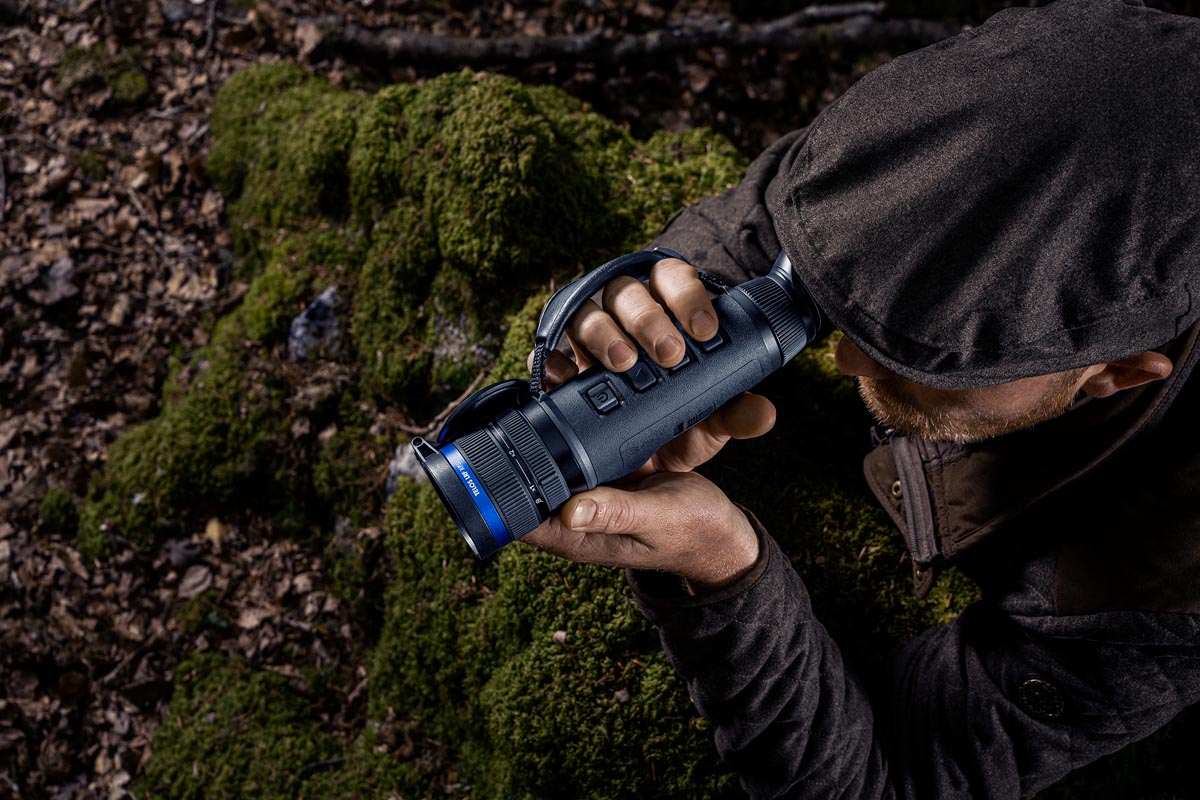
Where the XG50 pulls ahead
On open ground, the balance tips the other way. If you're watching a far hillside or a long paddock edge, the XG50's smaller pixels keep more detail on a distant animal, which helps you tell a fox from a cat or a sow from a boar before you move. Its narrower 8.8° view is the trade-off: Pulsar's 15.4 m at 100 m means more sweeps to cover the same ground.
Everything else is shared. Both run up to 8.5 hours on the LPS 7i battery, both use a 1024×768 AMOLED display, record to 64 GB and weigh 0.66 kg, or 0.72 kg in the LRF versions.
Which one to buy
The chart below sums it up.
For most Australian hunters who scan farmland, fence lines and creek country on warm nights, we'd choose the XP50. It's the more forgiving unit in the conditions we see most, and it costs less. Choose the XG50 if you mostly glass open country beyond 300 m and want the extra detail at distance. If you want both the wide view and more detail, the step up is the 1024×768 XL50, or the flagship covered in our Telos LRF XT50 review.
Compare the Telos XP50 and XG50
Check the current price and stock on each product page.
Telos XP50 Telos XG50Telos XP50 vs XG50 FAQ
Which is better for foxes, the Telos XP50 or XG50?
For most fox shooting on farmland, the Telos XP50 is the better choice. Its wider 12.4° view makes scanning quicker, and its lower NETD keeps a fox distinct on muggy, low-contrast nights. The XG50 puts more pixels on a fox at longer range, so choose it if you regularly spot foxes well past 300 m across open country.
Why does the Telos XP50 have a lower NETD than the XG50?
Pulsar rates the XP50's sensor at under 18 mK and the XG50's at under 40 mK. The XP50 uses larger 17 µm pixels, and a larger pixel gathers more heat energy, which is one reason it can separate smaller temperature differences. Sensor design and processing also play a part.
What does pixel pitch mean on a thermal monocular?
Pixel pitch is the size of each pixel on the thermal sensor, measured in microns. With the same lens, smaller pixels cover less ground each, giving more magnification and more pixels on a distant target, while larger pixels give a wider view and often better sensitivity. The Telos XP50 uses 17 µm pixels; the XG50 uses 12 µm.
Why is the Telos XG50's detection range longer than the XP50's?
Pulsar rates the XG50 at 2,300 m and the XP50 at 1,800 m because the XG50's smaller 12 µm pixels each cover less ground. At any given distance, the same target lands on more XG50 pixels, so it stays detectable further out. Detection only means seeing a heat source, not identifying the animal.
Is the Telos XP50 good in fog or rain?
It handles damp, low-contrast conditions better than most, thanks to Pulsar's under 18 mK sensor NETD, which helps separate small temperature differences. Heavy fog and rain still absorb thermal radiation and shorten what any thermal can see. The Telos is rated IPX7, so getting wet won't harm it.
Which has more magnification, the Telos XP50 or XG50?
The Telos XG50 has more. Pulsar lists it at 3.5× to 14×, against the XP50's 2.5× to 10×, both with up to 4× digital zoom. The XG50's higher base magnification comes from its smaller 12 µm pixels behind the same 50 mm lens, which also narrows its field of view.
Do the Telos XP50 and XG50 share the same battery and display?
Yes. Both use Pulsar's LPS 7i battery, rated at up to 8.5 hours at 22°C, and both have a 1024×768 AMOLED display, 64 GB of built-in memory and 1024×768 video recording. They also weigh the same: 0.66 kg, or 0.72 kg for the LRF versions with a built-in rangefinder.
What sensor does the Telos XP50 use?
Pulsar says the Telos LRF XP50 uses a 640×480 Lynred thermal sensor made in France, with 17 µm pixels and a sensor NETD under 18 mK. The XG50 uses a 640×480 sensor with smaller 12 µm pixels. Both sit behind the same 50 mm F1.0 lens.
What is the minimum focus distance of the Telos XP50?
Pulsar's support pages list the minimum focusing distance of the Telos XP50 as 5 m. Closer than that, the image can't be brought fully into focus with the front focus ring. For a thermal monocular used to scan paddocks and treelines, that rarely matters, but it's worth knowing for close checks.
Specifications are from Pulsar's published figures and support pages; pixel coverage figures are our own calculation.