

Review
Pulsar Telos XQ35 Review: Is the Entry Telos Enough?
You've spent a few nights with a borrowed thermal and want your own, but the Telos range covers a wide spread of prices. The Telos XQ35 is the entry point, and for close-country work it's enough. If most of your foxes, pigs and deer turn up inside about 150 m, it'll find them and show you what they are. If you regularly look further, or hunt muggy nights, the XP50 is the better buy for not much more.
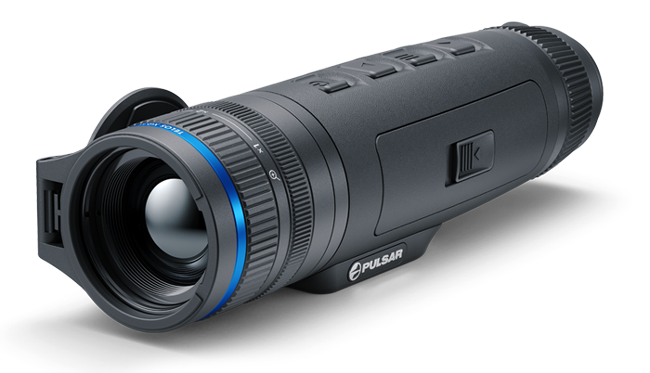
It shares the full Telos body with the flagship: the front focus and zoom rings, the symmetrical buttons, the IPX7 housing and the LPS 7i battery. What changes is the sensor and lens. For the whole range, see our Pulsar Telos buyer's guide.
What you give up at the entry level
The XQ35 uses a 384×288 sensor with 17 µm pixels behind a 35 mm F1.0 lens. Its nearest step up, the Telos XP50, has the same pixel size but 640×480 of them behind a 50 mm lens. The comparison below shows how that plays out.
Each XQ35 pixel covers about 4.9 cm at 100 m, by our calculation, against 3.4 cm on the XP50. So a fox lands on fewer pixels, and you run out of detail sooner. By our estimate in how far a Telos can identify a fox, pig or deer, the XQ35 identifies a fox at around 80 m and recognises it as fox-sized at around 170 m. Pulsar rates its detection range at 1,300 m.
Sensitivity holds up better than you might expect. Pulsar rates the XQ35's sensor NETD at under 25 mK and the system at under 18 mK, so it still gives a clean picture on cool nights.
Where it makes sense
Say you hunt deer in thick timber and blackberry in the high country, or check a few paddocks bounded by scrub. Sightlines rarely open past 150 m, and you're walking a lot. That's where the XQ35 fits. Its 3× base magnification and 10.7° view keep close animals large on screen, and at 0.57 kg it's the lightest Telos, as the chart below shows.
It also keeps all the Telos extras: a 1024×768 AMOLED display, 64 GB of recording, Wi-Fi to the Stream Vision 2 app, and up to 8.5 hours per battery. For a first thermal, that's a well-equipped tool rather than a stripped-down one.
LRF XQ35 or XP50?
This is the decision most XQ35 buyers end up facing. The Telos LRF XQ35 adds a 1,000 m laser rangefinder, and at Xhunter it sits close in price to the standard XP50. The chart below is how we'd decide.
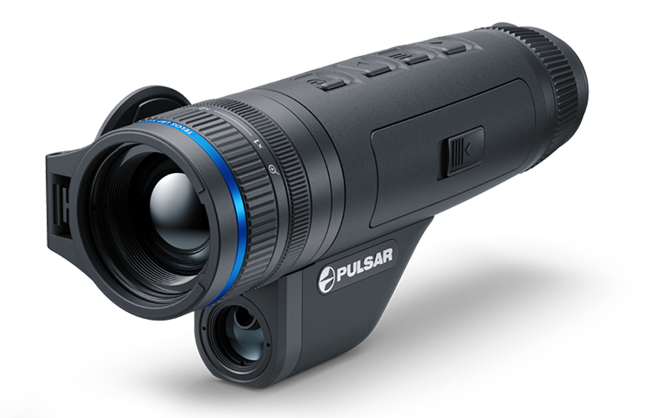
If knowing the exact distance is part of every decision you make, the LRF XQ35 earns its place. For most buyers, though, we'd put the money into the XP50's bigger sensor: more pixels on every animal, a wider 21.8 m view at 100 m and a lower NETD for muggy nights. Our XP50 vs XG50 comparison covers that model in detail.
Our verdict
The Telos XQ35 is a sound first thermal for close-country hunters who walk a lot and rarely look past 150 m. It's light, simple to use and has everything the bigger models have except the sensor. Skip it if you hunt open paddocks, glass at distance or want to identify animals before you approach; the XP50 does all of that better, and the flagship covered in our Telos LRF XT50 review does it best.
Pulsar Telos XQ35 at Xhunter
Check the current price and stock on the product pages.
Telos XQ35 Telos LRF XQ35Telos XQ35 FAQ
Is the Pulsar Telos XQ35 good enough for foxes?
Yes, at shorter ranges. By our estimate using the Johnson criteria, the Telos XQ35 identifies a fox at around 80 m and recognises a fox-sized animal at around 170 m. That suits close country and smaller paddocks. If you regularly spot foxes past 150 m, a Telos XP50 or a 12 µm model will show them in more detail.
Should I buy the Telos XQ35 or the XP50?
Buy the XQ35 if you hunt close country, walk a lot and want the lightest, lowest-cost Telos. Buy the XP50 if you look past 150 m or hunt humid, low-contrast nights. The XP50's 640×480 sensor puts more pixels on every animal, gives a wider 21.8 m view at 100 m and has a lower NETD.
Is the Telos LRF XQ35 worth it over the standard XQ35?
It's worth it if you range animals before most decisions. The LRF XQ35 adds a 1,000 m laser rangefinder with ±1 m accuracy and weighs 0.63 kg against 0.57 kg. If you mainly scan known ground at short range, the standard XQ35 does the same imaging job for less.
How far can the Telos XQ35 detect a heat source?
Pulsar rates the Telos XQ35's detection range at 1,300 m, measured against a 1.8 × 0.5 m target. That means noticing a heat source, not identifying it. By our estimate, the XQ35 identifies a fox at around 80 m, a pig at around 160 m and a deer at around 200 m.
What is the field of view of the Telos XQ35?
Pulsar lists the Telos XQ35's field of view as 10.7° horizontally, which covers 18.7 m at 100 m. That's narrower than the XP50's 21.8 m because the XQ35 has fewer pixels across its sensor. Its 3× base magnification keeps close animals large on screen.
How much does the Telos XQ35 weigh?
Pulsar lists the Telos XQ35 at 0.57 kg, making it the lightest model in the Telos range. The LRF XQ35 with its built-in rangefinder weighs 0.63 kg. The 50 mm Telos models weigh between 0.66 and 0.73 kg, so the XQ35 is the easiest to carry on long walks.
Does the Telos XQ35 have the same display and recording as bigger models?
Yes. The Telos XQ35 has the same 1024×768 AMOLED display, 64 GB of built-in memory and 1024×768 video and photo recording as the XG50, XP50 and XL50. It connects to the Stream Vision 2 app over 2.4 or 5 GHz Wi-Fi. Only the flagship LRF XT50 has a higher-resolution display and more memory.
What is the NETD of the Telos XQ35?
Pulsar rates the Telos XQ35's sensor NETD at under 25 mK and its system NETD at under 18 mK. Lower numbers mean the device can separate smaller temperature differences, which helps on low-contrast nights. That's better than the 12 µm XG50 and XL50 sensors, though not as low as the XP50's under 18 mK sensor rating.
What magnification does the Telos XQ35 have?
Pulsar lists the Telos XQ35 at 3× to 12× magnification, with up to 4× digital zoom. Its 3× base magnification is higher than the XP50's 2.5×, which helps show close animals larger. The zoom ring on the objective changes magnification smoothly with one hand.
How long does the Telos XQ35 battery last?
Pulsar rates the Telos XQ35 at up to 8.5 hours on its LPS 7i battery at 22°C, the same as the XP50 and XG50. The battery is replaceable, charges through USB-C with Power Delivery and supports wireless charging. Recording, Wi-Fi and cold weather will reduce the runtime.
Can the Telos XQ35 be upgraded to a better sensor later?
Pulsar lists sensor and objective lens upgrades among the possible Telos upgrade types, alongside adding a rangefinder. What's currently offered for a specific unit in Australia, and at what cost, can change. Choose the model that suits your needs now, and check with us before buying with a future upgrade in mind.
This review is based on Pulsar's published specifications; pixel and range figures are our own estimates; price comparisons refer to Xhunter's listings in November 2026.